Arab Online Casino Access and UAE Licensing
At the time of writing, commercial iGaming requires a valid local gaming licence from the General Commercial Gaming Regulatory Authority, or GCGRA. The GCGRA states that it has exclusive federal jurisdiction over commercial gaming, including online gaming, remote gaming, and casino gaming. Questions about casino legality across Arab countries therefore require a jurisdiction-specific answer.
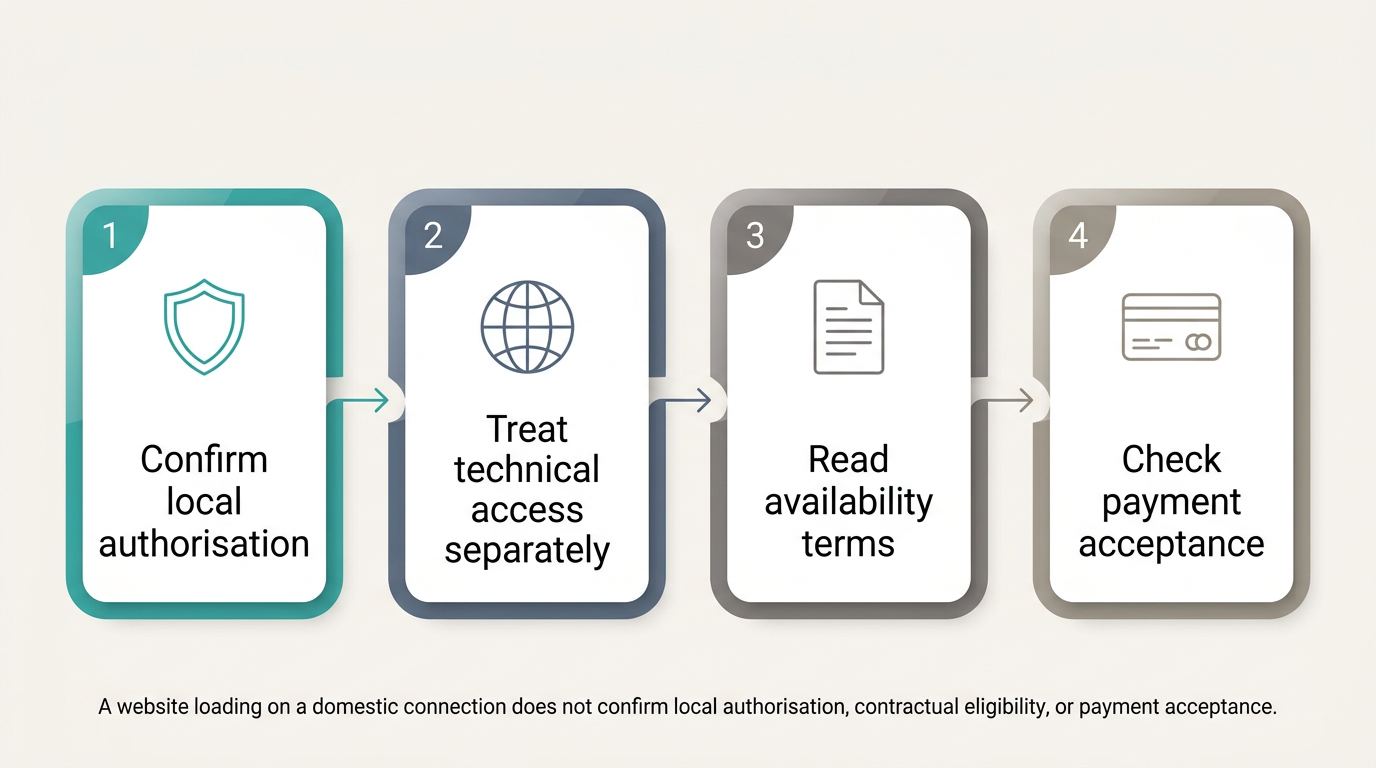
A foreign regulator licenses an international operator in another jurisdiction; local permission and resident eligibility require separate confirmation. Apply the following checks in order.
A website loading on a domestic connection does not confirm local authorisation, contractual eligibility, or payment acceptance.
- Confirm local authorisation. Check the live GCGRA licence information for the legal entity, exact domain, active status, and iGaming scope. Only entities the GCGRA licenses may conduct commercial gaming in the Emirates. A badge, older article, or affiliate list does not replace the regulator register.
- Treat technical access separately. Geolocation controls and DNS blocking can affect a domestically targeted site's availability. A site may load through a changed technical route while remaining unavailable under its terms or outside local authorisation. A casino VPN can also trigger account closure, withheld withdrawals, or reduced dispute options if location controls were bypassed.
- Read the operator's full availability terms. Check whether the platform expressly accepts residents, restricts particular Emirates like Abu Dhabi, or excludes locally issued identity documents and cards. International licences for iGaming or regulated remote gambling apply only within their stated scope and jurisdiction.
- Check payment acceptance last. Card, wallet, and processor acceptance depends on factors like the bank, merchant coding, processor, and operator. Google's gambling-and-games advertising policy for the Emirates requires online gaming and iGaming advertisers to hold GCGRA licensing, but advertising eligibility does not confirm that a particular casino service is suitable or available to you. Payment acceptance can change at any point and is not a stable nationwide feature.
The new Federal Decree-Law No. 25 of 2025 was reported as taking effect on 1 June 2026 and removing gambling provisions from the Civil Transactions Law. This is a narrow civil-enforceability development. It does not provide blanket approval for casinos licensed abroad, so live information from the regulatory authority GCGRA remains the relevant reference point for iGaming regulation.
Assess an International Casino Before Creating an Account
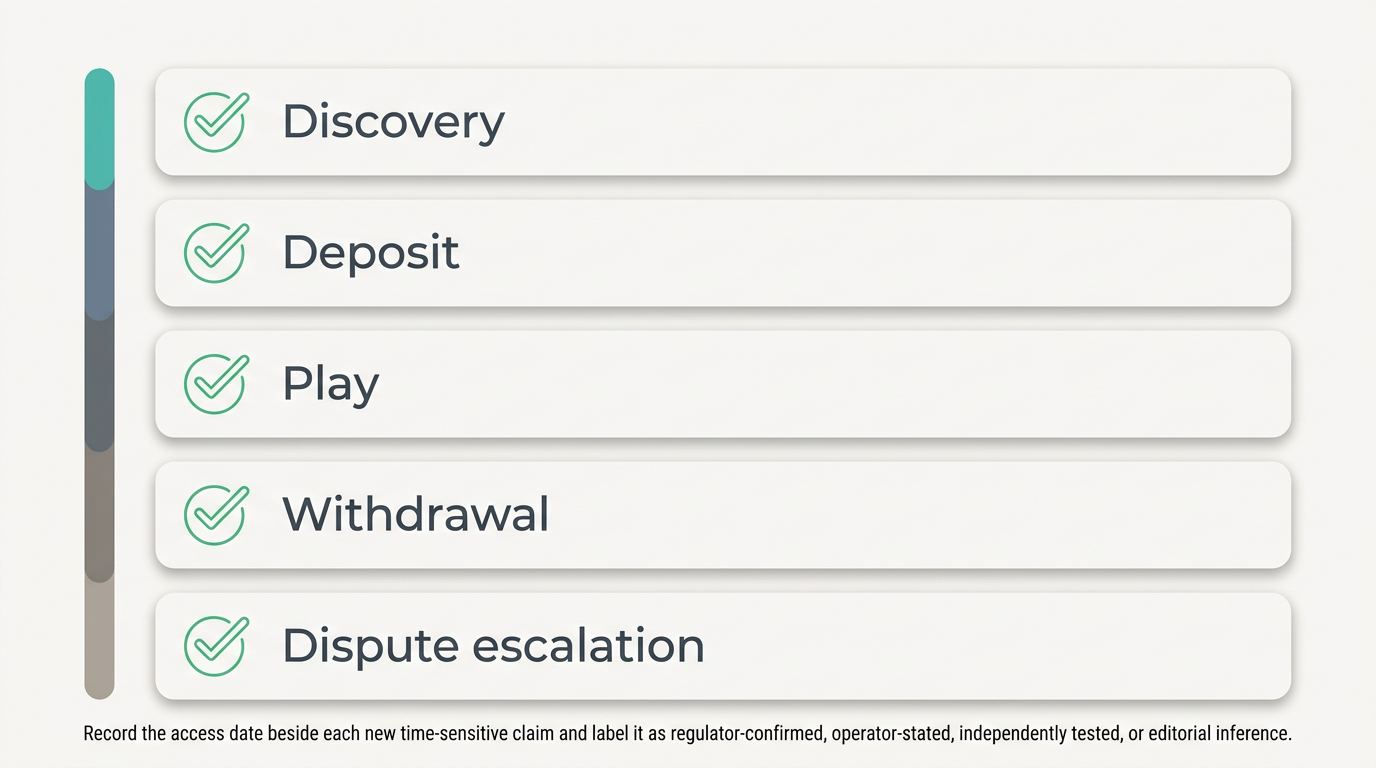
A local reader should base an assessment of an international iGaming operator on documents, regulator-register entries, and observable terms. Broad claims that a platform is safe or licensed do not provide that basis. Record the access date beside each new time-sensitive claim and label it as regulator-confirmed, operator-stated, independently tested, or editorial inference.
Use this pre-deposit audit across the new account journey.
- Discovery: Verify the contracting legal entity, exact domain, when the operator was first licensed, active licence status, licence scope, and regulator-register entry. Compare names in the footer, terms, privacy notice, and licence record. Mismatched corporate names, copied licence claims, missing ownership disclosures, or frequently changing terms require further scrutiny.
- Deposit: Review casino payment methods before entering card details. An AED display may only be a reference currency, while settlement occurs in USD, EUR, GBP, or another currency. Check conversion timing, exchange-rate spread, processor and transaction fees, withdrawal charges, limits, pending periods, dormant-account terms, and the treatment of bonus-linked balances.
- Play: Confirm that the site uses valid SSL encryption and check the game suppliers it identifies.
- Withdrawal: Expect full new account verification through know your customer verification, commonly called KYC. Operators may conduct age verification, sanctions screening, source-of-funds checks, identity-document retention, and anti-money-laundering, or AML, controls before deposits or withdrawals. Unclear verification requirements or aggressive VIP contact are observable warning signs.
- Dispute escalation: Save evidence before a dispute develops. A foreign licence may offer complaint routes or independent dispute resolution, yet it cannot guarantee court remedies in the United Arab Emirates, local enforcement, or recovery of funds.
iGaming bonuses need the same document-based review. Read wagering requirements, game-contribution rates, maximum-bet rules, expiry dates, excluded games, cashout caps, and whether a balance is sticky. A sticky balance limits withdrawal treatment because bonus funds may remain with the operator after eligible winnings are withdrawn, at which point the bonus is forfeited.
| Licence-review criterion | Player-facing outcome to check |
|---|---|
| Contracting entity and licence scope | Identifies who holds the account agreement and which services the licence covers |
| Funds handling | States whether player balances receive separate handling or other stated safeguards |
| Game-integrity testing | Provides current audit scope, testing information, and a route to report a malfunction |
| Privacy practices | Explains document retention, international data processing, and account-data access |
| Complaint route | Names the internal escalation process and any external dispute option |
| Self-exclusion availability | Shows whether account restrictions can be activated and how they apply |
A licensed iGaming site can provide useful public evidence, while a safe platform claim remains incomplete without matching records for the entity, domain, licences, and terms.
Retain dispute evidence. Save screenshots, transaction records, chat transcripts, emails, the relevant versions of terms and conditions, and game-round references for delayed withdrawals, failed KYC, account closure, payment reversal, game malfunction, or terms changed after a win.
Casino Games at an Arab Online Casino and Fair Play

The pre-deposit audit lets readers check whether an operator publishes credible information. Readers can use game-level details to assess how each iGaming title can affect a fixed AED budget through stake size, pace, and strategy. Gambling means risking money on an uncertain outcome, while wagering means placing the stake.
| Game format | How outcomes work | Decision factor |
|---|---|---|
| Slots and slot machines | A random number generator, or RNG, determines each result | Volatility and published game return to player, or RTP |
| Roulette and baccarat | RNG software or a live dealer deals or spins | Variant rules and speed |
| Blackjack online | Cards determine the hand, with player decisions under published rules | Dealer rules, deck number, and strategy |
| Poker | Other participants' decisions affect peer-to-peer results | Opponent skill and fees |
| Live dealer games | A streamed studio deals physical cards or spins a wheel | Table availability, pace, and rules |
| Provably fair products | Cryptographic information can allow result verification | Whether the verification method is explained |
Casino games that use an RNG should show testing or independent game-lab certification. Live dealer games use a streamed studio, while peer-to-peer poker depends partly on other players. Check published rules, full RTP disclosures where available, and the route for reporting a malfunction. RTP measures long-run theoretical returns without predicting results for one player or session. House edge describes the corresponding expected cost over time. Bet size, volatility, game speed, and session length determine how quickly a budget may be used and the chances of an early loss. Blackjack and roulette labels alone do not identify the same expected outcome because rules, variants, and RTP settings can differ among new releases, while land-based and online gaming variants may also apply different rules and strategy considerations.
Illustrative AED budget: With AED 200, hypothetical AED 10 bets create 20 rounds before losses or returns are considered. At one round per minute, that is 20 minutes; at four rounds per minute, it is five minutes. Actual results remain uncertain for new players.
Free-play demonstrations, probability examples, and non-deposit learning options can help readers understand new online games before monetary play.
Mobile Access and Account Controls
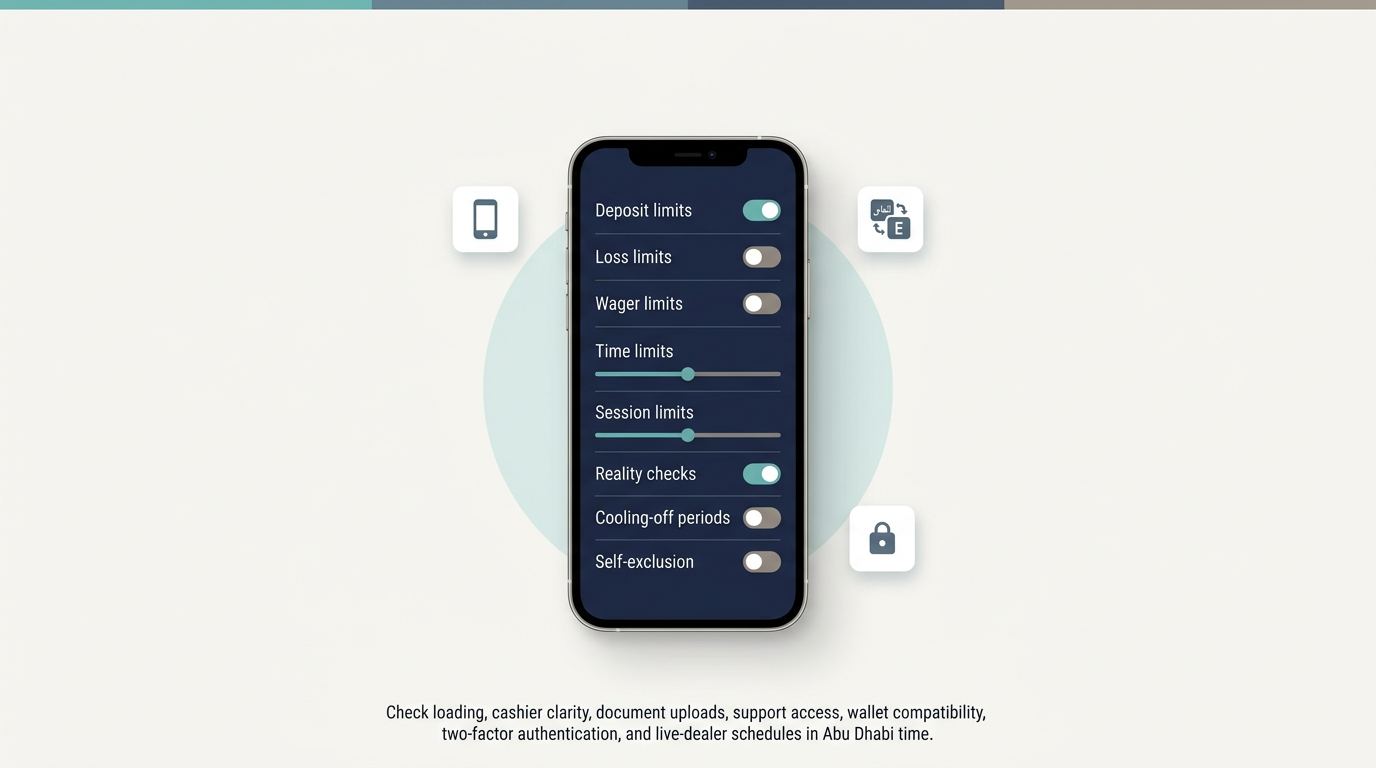
Game information only helps if a reader based locally can read terms, complete account steps, and apply limits on the smartphone used for one account. A mobile iGaming platform should present accurate Arabic and English conditions and avoid unclear translation that degrades the gaming experience.
- Check loading, cashier clarity, document uploads, support access, wallet or payment-token compatibility, two-factor authentication, and full live-dealer schedules in Abu Dhabi time.
- Compare Arabic and English wording for wagering, withdrawal, privacy, and responsible gambling terms. One risk is that right-to-left display errors or conflicting translations can change account conditions and damage the gaming experience.
- Read the full privacy notice before submitting documents. International operators may process identity, payment, device, and location data from local accounts outside the country.
- Confirm that Arabic-language support can answer account-specific questions through one of the stated contact routes.
Check account controls before they are needed.
- Verify that deposit limits, loss, wager, time, and session limits function for resident accounts.
- Check reality checks, which are reminders of elapsed time or spending, plus cooling-off periods, self-exclusion, and marketing opt-outs.
- Confirm whether control requests receive written confirmation and how they apply to any remaining balance.
Frequently Asked Questions About Arab Online Casinos in the UAE
The FAQs cover narrower account and access situations alongside the main UAE casino guidance.
Can a casino apply dormant-account terms to an unused balance?
Yes, if disclosed terms allow it. Review the inactivity period, notice process, and bonus-linked balance treatment, then retain one applicable terms version and your account records.
What should a UAE resident do if a card issuer reverses a casino transaction?
Contact the card issuer and operator through documented channels. Keep card statements, transaction identifiers, cashier records, and correspondence, because a reversal may restrict the full account balance pending review.
Why might a live-dealer table be unavailable at a particular time in the UAE?
Studio schedules, seat capacity, maintenance, geolocation settings, and Abu Dhabi time conversion can affect availability. Check the displayed time zone, table schedule, and any account eligibility notice.